Retail POS that answers head office.
Helmsman builds custom point of sale (POS) software for retailers with one store or many: billing, returns and tax at the counter, with offline support so the counter keeps selling when the connection drops. Items and prices are managed centrally and pushed to every store, so head office sees store-wise and item-wise sales without assembling the picture by hand.
From $3,000Typically $3,000 to $80,000See pricing
Last updated
Who needs a retail POS?
You probably need it if…
- You can bill at the counter, but cannot easily say which stores are performing.
- Each store keeps its own item list and prices, so no two bills are quite comparable.
- A dropped internet connection means a queue at the counter.
- Head office builds the sales picture by hand from each store's figures.
- Nobody can say which items actually move and which only sit on the shelf.
What does a retail POS include?
- 01
Counter billing
Billing that keeps the queue moving
Bills raised from your own item list and prices, with the payment mode recorded on every sale.
- 02
Returns & reprints
Returns handled properly
Returns and reprints recorded against the original bill, so every refund can be traced.
- 03
Tax on every bill
The tax split, already done
Tax worked out and shown on each bill, so the figures accounts needs are already there.
- 04
Offline support
Keeps selling when the line drops
Billing carries on at the counter when the connection drops, and the sales are sent on when the line is back.
- 05
Central item list
One item list, every store
Items and prices managed centrally and pushed to each store, so every bill across the chain is comparable.
- 06
Store-wise reporting
Head office sees every store
Store-wise sales, item-wise movement and payment-mode analysis from the same transactions, without waiting for a consolidation.
- 07
Integrations
Connected to stock and accounts
Counter sales connected to stock, purchase and your accounting software or ERP, so what was sold reaches the books without being typed again.
How does Helmsman deliver a retail POS?
The full approachA POS project starts at the counter. Helmsman watches how billing, returns and payments happen in your stores, then sits with head office to agree which numbers it needs and how often. The requirement document records both, so the system serves the cashier and the management report at the same time.
The system is designed for speed at the counter and built in stages you review as they come together. Items and prices are set up centrally, staff are trained, and the POS is rolled out store by store. It keeps evolving after go-live: adding a store is usually a change in settings, not a rebuild.
- 01UnderstandProcess map
- 02AnalyseRequirement document
- 03ArchitectSolution structure
- 04DesignScreens and flows
- 05DevelopWorking software
- 06ImplementLive system
- 07EvolveOngoing support
One till system, country by country
A retail point of sale for shops in Southern Africa: tills that keep selling offline, a head office that sees every shop, and fiscal tax compliance.
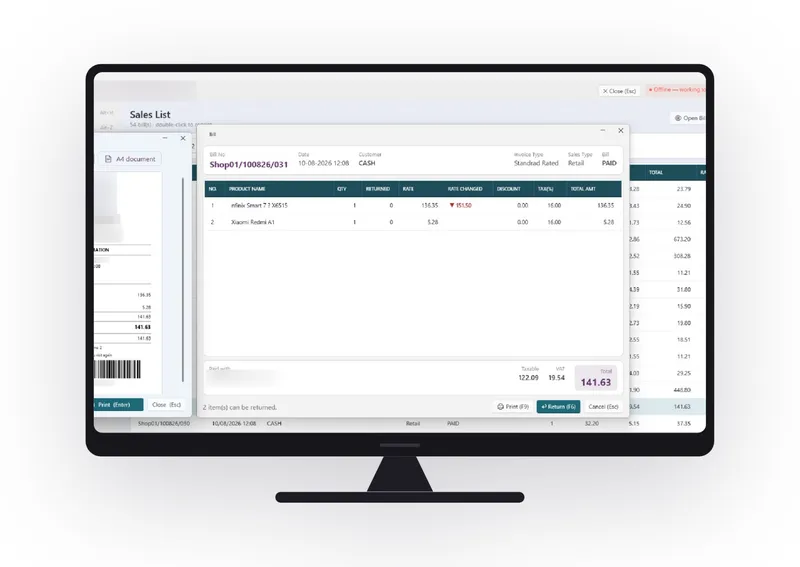
Retail billing, and the numbers behind it
A multi-store electronics retailer in the UAE, with a point of sale built to run the counter and answer head office.
Industries we build this for
POS questions, answered.
What is POS software?
POS (point of sale) software is what a store uses to bill customers at the counter, take payment, handle returns and record every sale. Retail POS for several stores also keeps items and prices consistent across the chain and reports each store's sales to head office.
Does the POS keep working if the internet goes down?
Yes. The POS Helmsman built for a multi-store retailer has offline support, so the counter keeps selling when the connection drops.
Can head office manage items and prices for all stores?
Yes. Items and prices are managed centrally and pushed to each store, so every store bills from the same items and prices and every bill is comparable.
What reports does head office get from the POS?
Store-wise sales, item-wise movement and payment-mode analysis, drawn from every transaction. Head office sees how each store and product line is performing without waiting for a consolidation.
Can the POS connect to our ERP or accounting software?
Usually yes, if that software has a way in, such as an API or a data export. Sales at the counter can then reach stock, purchase and accounts without being typed again.
Can Helmsman also build an online store connected to our stock?
Yes. Helmsman builds e-commerce storefronts connected to real stock and pricing, so what is sold online is what is on the shelf.